Daylight and artifical light analysis

Daylight analysis Existing house
It is not a surprise for the inhabitants when they see the daylight analysis plot. Not only the illumination levels in Belgium are not so high but the orientation of the building is not really well considered. Daylight penetration are too low. Artificial lights are, at least during the winter, required the hole day as well.
The daylights levels are analysed at a plane 700mm above the ground. This is for the ground floor analysis grid. The main part of the this floor at +- 18 lux. What is way below the required levels. Artificial light will be necessary, also during the day.

The first floor is not better. There should be a little bit more illumination, but because of the walls and the smaller windows at the front and rear facade the lightlevels are low. The lightblue zone indicates 15 lux.

The living room lighting level is a bit higher. The main part of the room is at 40 lux.

Artificial lighting analysis Existing house
Because of the history of the building, there are not a lot of light points installed. For the moment all those light points are fitted with an incandescent bulb from +- 60W. Because of this is not enough for the occupants, heaps of auxiliary lights are installed. These auxiliary lights are not considered in this Ecotect model.
The result of the model for the artifical lighting also match the reality: Lighting levels are too low! The yellow parts are at 300 lux, which is good, but there is not an equal spread in the room at all. This will cause a “glare-effect” . The lightblue indicates 9 lux ...

Same image can be given at the first floor. As the rooms are a bit smaller and the cieling is less high the illuminosity in those rooms is a bit higher. 18 lux for the light blue regions and 519 lux for the bright yellow regions.

Also the living room is not well lit. The few incandescent lights are not sufficient.
How to improve?
How to improve the low lighting levels?
-
1. Increase the window surfaces everywhere you can an use double glassed windows as advised in the thermal analysis.
-
2.Increase artificial lighting by increasing the number of lights and by the use of diffusers
-
3.Use, where possible, bright colored, reflective wall and ceiling paint.
A list of the required lighting levels by the European Commission can be downloaded from the download page. Basically it tell us the required lighting levels for different rooms:
-
•Offices and similar rooms : 500 Lux
-
•Entrance halls : 300 to 800 lux
-
•Toilets: 250 lux
-
•Kitchens: 500 lux
-
•Archives: 250 lux
At this latitude it is almost impossible to meet this requirements without artificial lighting.
Daylight analysis NEW house
By increasing the window sizes and creating new ones the daylight levels so up from the min 18 Lux to 41 lux in the light blue area’s. The living room will increase it’s average to 128 Lux.
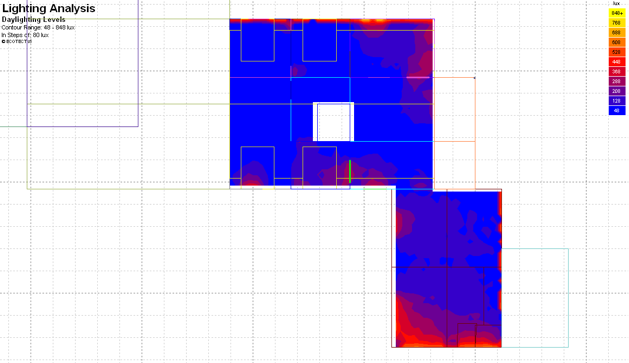
Also on level one the window sizes have been increased. There was also a little shift with the bedrooms. The daylight levels raised form 15 Lux to 40 Lux. The mezzanine in the living room is going to be the place to read during the day.

The artificial light analysis respond on the increase of lights installed in the model. There is a little bit of glare in the kitchen, but this is just because all light are on at the same time. The model indicates 800 Lux and normally 500 Lux should be enough.
