Shading analysis

Sunpath

Analysing the sunpath diagram, the house would get a 0 for orientation. Bedrooms and kitchen, at the back of the house, don’t have any direct sunlight from half October till the end of February. More than 50% of the windows point in this direction. In the summer, the bedroom does get the morning sun, which is good.
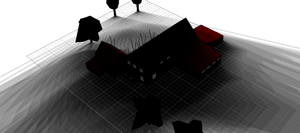
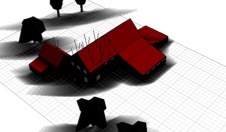
July shading during a day January shadings during a day
Roof shading
Before thinking of putting solar collectors or pv modules on the roof, it should be analysed for possible shading losses. Are the trees shading the roof ? Is the main roof shading parts of the other roofs?
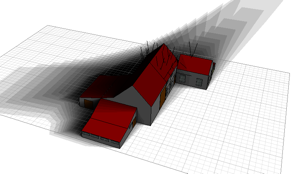
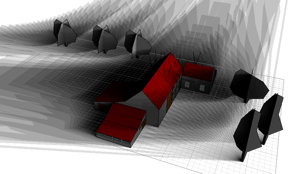
As trees are less of an issue to cut short, there are only two roof surfaces viable for solar energy:
-
1.Main roof above habitation and barn, South-East side
-
2.Less suitable but still fine; living roof pointing South-West
Which roof part has got the most irradiation?
In order to determine the best roof part to put solar devices on, a irradiation analysis is needed. There are two possible roof orientations: S-E (-36°) or S-W (54°), assuming South is azimuth=0°.
-
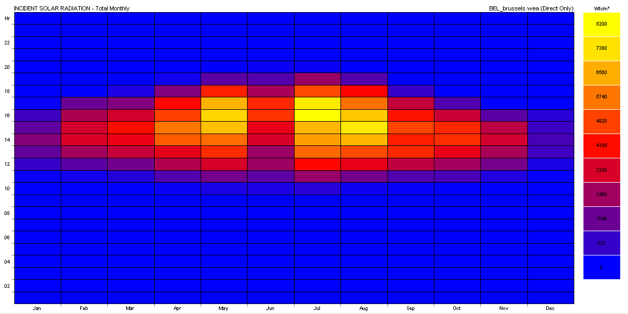
1.The incident solar irradiation analysis on the roof above the living room (54°):
-
2.The incident solar irradiation analysis on the main roof (-36) :

These are nice graphs, where we do see a dip in june, but it’s hard to compare both. Plotting the results in a spreadsheet will give a better idea :
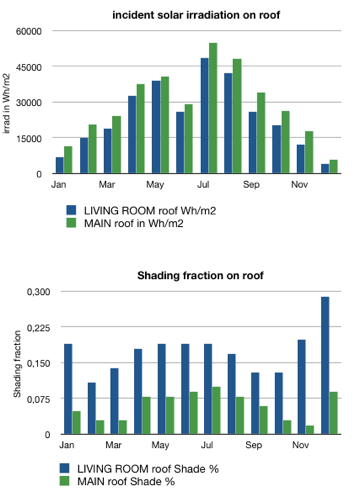
The irradiation on the main roof is slighty higher than the one in the living room’s roof. the difference is 58.64 kWh/year.
The shading of the roof surfaces clarifies a lot of the above data. Shading losses of the living room’s roof are much higher, due to shading from the trees and from the main roof, as discussed in the beginning of this page. Therefore, installing a solar system on the living room’s roof is less advisable.
This site is made by Raphael JANSSENS for the SOLA9009 course at the UNSW. The main goal is to analyse the buildings energy performance to advise and support the planned renovations to the habitation area.